
STALIN PROPAGANDA AND REALITY: The reign of Josef Stalin was a time of terror, mass executions, brutal collectivization, and the most horrific Propaganda was considered vital in maintaining control and favour. The dictators who implemented terror and propaganda to their tyrannical regimes were Stalin & Hitler. Propaganda is the organized and controlled spreading of information to influence and control the views of people and how they think. This then leads them to behave in a certain way The function of the "Hitler myth" was to legitimize Nazi rule, while the function of the "Stalin myth" was to legitimize not Soviet rule itself but Stalin's leadership within the Communist Party. Stalin's personality cult existed precisely because Stalin knew that he was replaceable and feared that he might be replaced, and so needed to bolster his authority as much as blogger.comted Reading Time: 14 mins
Comparison of Nazism and Stalinism - Wikipedia
Some authors have carried out comparisons of Nazism and Stalinism. They have considered the similarities and differences between the two ideologies and political systemsthe relationship between the two regimesand why both came to prominence simultaneously. During the 20th century, the comparison of Nazism and Stalinism was made on totalitarianismideologyand personality cult. Both regimes were seen stalin and hitler propaganda contrast to the liberal-democratic Western world, emphasizing the similarities between the two.
Political scientists Hannah ArendtZbigniew Brzezinskiand Carl Joachim Friedrichand historian Robert Conquest were prominent advocates of applying the totalitarian concept to compare Nazism and Stalinism. Other historians and political scientists have made comparisons between Nazism and Stalinism as part of their work.
The stalin and hitler propaganda of Nazism and Stalinism has long provoked political controversy, [9] [10] and in the s led to the historians' dispute within Germany known as the Historikerstreit. Hannah Arendt was one of the first scholars to publish a comparative study of Nazi Germany and Stalin's Soviet Union.
In her work The Origins of TotalitarianismArendt puts forward stalin and hitler propaganda idea of totalitarianism as a distinct type of political movement and form of government, which "differs essentially from other forms of political oppression known to us, such as despotism, tyranny, stalin and hitler propaganda, and dictatorship. Not all totalitarian movements succeed in creating totalitarian governments once they gain power. In Arendt's view, although many totalitarian movements existed in Europe in the s and s, only the governments of Stalin and Hitler succeeded in fully implementing their totalitarian aims.
Arendt traced the origin of totalitarian movements to the 19th century, focusing especially on antisemitism and New Imperialism.
She emphasized the connection between the rise of European nation-states and the growth of antisemitism, which was because the Jews represented an "inter-European, non-national element in a stalin and hitler propaganda of growing or existing nations.
According to Arendt, these were the first political organizations in Europe that claimed to represent the interests of the whole nation instead of the interests of a class or other social group. European imperialism of the 19th century, stalin and hitler propaganda, better known as New Imperialismalso paved the way for totalitarianism by legitimizing the concept of endless expansion.
Arendt refers specifically to the pan-movements of pan-Germanism and pan-Slavismwhich promised continental empires to nations with little hope of overseas expansion. Arendt posits that both the Nazi and Bolshevik movements "recruited their members from mass of apparently indifferent people whom all other parties had given up", [22] and who "had reason to be equally hostile to all stalin and hitler propaganda. Their target stalin and hitler propaganda did not have to be persuaded to despise the other parties or the democratic system, because it consisted of people who already despised mainstream politics.
As a result, totalitarian movements were free to use violence and terror stalin and hitler propaganda their opponents without fear that this might alienate their own supporters, stalin and hitler propaganda.
They presented opposing ideas as "originating in deep natural, social, or psychological sources beyond the control of the individual and therefore beyond the power of reason.
Totalitarian governments make extensive use of propaganda and are often characterized by having a substantial distinction between what they tell their own supporters and the propaganda they produce for others. Indoctrination consists of the message that a totalitarian government promotes internally to the members of the ruling party and that segment of the population that supports the government. Propaganda consists of the message that a totalitarian government seeks to promote in the outside world and among parts of its own society that may not support the government.
The indoctrination used by the Soviets and the Nazis was characterized by claims of "scientific" truth and appeals to "objective laws of nature. Arendt identifies this as being in specific ways similar to modern advertisingstalin and hitler propaganda, in which companies claim that scientific research shows their products to be superior; however, she posits more generally that it is an extreme version of "that obsession with science which has characterized the Western world since the rise of mathematics and physics in the sixteenth century.
According to Arendt, totalitarian governments did not merely use these appeals to supposed scientific laws as propaganda to manipulate others.
Totalitarian leaders like Hitler and Stalin genuinely believed that they were acting in accordance with immutable natural laws, to such an extent that they were willing to sacrifice the self-interest of their regimes for the sake of enacting those supposed laws. They planned to depopulate Eastern Europe to make way for colonists from the German Herrenvolk "master race"even though this actively harmed their war effort.
Arendt also identifies the central importance of an all-powerful leader in totalitarian movements. The totalitarian leader does not rise to power by personally using violence or through any special organizational skills but by controlling personnel appointments within the party so that all other prominent party members owe their positions to him.
Even when the leader is not particularly competent and the members of his inner circle are aware of his deficiencies, they remain committed to him out of fear that the entire power structure would collapse without him. Once in power, stalin and hitler propaganda, according to Arendt, stalin and hitler propaganda, totalitarian movements face a major stalin and hitler propaganda they built their support based on anger against the status quo and on impossible or dishonest promises, but now they have become the new status quo and are expected to carry out their promises.
According to Arendt, totalitarian governments must constantly be fighting enemies in order to survive. This explains their irrational behaviour, such as when Hitler continued to make territorial demands even after he was offered everything he asked for in the Munich Agreementor when Stalin unleashed the Great Terror even though he faced no significant internal opposition. Arendt highlights the widespread use of internment camps by totalitarian stalin and hitler propaganda, positing that they are the most important manifestation of the need to find enemies to fight against, and are therefore "more essential to the preservation of the regime's power than any of its other institutions.
Slaves were abused and killed for the sake of profit; concentration camp inmates were abused and killed because a totalitarian government needed to justify its existence. Throughout her analysis, Arendt emphasized the modernity and novelty of the governmental structures set up by Stalin and Hitler, arguing that they represented "an entirely new form of government" which is likely to manifest itself again in various other forms in the future.
The totalitarian paradigm in the comparative study of Nazi Germany and the Soviet Union was further developed by Carl Friedrich and Zbigniew Brzezinskiwho wrote extensively on this topic both individually and in collaboration. Similar to Hannah Arendt, they state that "totalitarian dictatorship is a new phenomenon; there has never been anything quite like it before.
In particular, it is distinguished by a reliance on modern technology and mass legitimation, stalin and hitler propaganda. Unlike Arendt, stalin and hitler propaganda, Friedrich and Brzezinski apply the notion of totalitarian dictatorship not only to the regimes of Hitler and Stalin but also to the Soviet Union throughout its entire existence as well as the regime of Benito Mussolini in Italy and the People's Republic of China under Mao Zedong.
Friedrich stated that the "possibility of equating the dictatorship of Stalin in the Soviet Union and that of Hitler in Germany" has been a deeply controversial topic and a subject of debate almost from the beginning of those dictatorships.
Friedrich and Brzezinski posit that Nazism and Stalinism are not only similar to each other, but also represent a continuation or a return to the tradition of European absolute monarchy on certain levels. In Stalinism and Nazism, stalin and hitler propaganda, the leader likewise held all real power and was considered accountable only to various intangible entities, such as "the people", "the masses", or "the Volk"; the common feature of autocracies, stalin and hitler propaganda, whether monarchical or totalitarian, is the concentration of power in the hands of a leader who cannot be held accountable by any legal mechanisms, stalin and hitler propaganda, and who is supposed to be the embodiment of the will of an abstract entity.
Friedrich and Brzezinski believe that there is also an underlying political cycle in which rising discontent leads to increased repression until the stalin and hitler propaganda is eliminated. Controls are relaxed until the next time that popular dissatisfaction begins to grow. Placing Stalinism and Nazism within the broader historical tradition of autocratic government, Friedrich and Brzezinski hold that "totalitarian dictatorship, in a sense, is the adaptation of autocracy to twentieth-century industrial society.
Totalitarianism can only exist stalin and hitler propaganda the creation stalin and hitler propaganda modern technology, because such technology is essential for propagandasurveillance of the population, and the operation of the secret police.
Meanwhile, Fascists wish to "establish the imperial predominance of a particular nation or race. In terms of the similarities between Nazism and Stalinism, Friedrich lists five main aspects that they hold in common: First, an official ideology that is supposed to be followed by all members of society, at least passively, and which promises to serve as a perfect guide towards some ultimate goal.
Second, stalin and hitler propaganda, a single political partycomposed of the most enthusiastic supporters of the official ideology, stalin and hitler propaganda, representing an elite group within society no more than 10 per cent of the populationand organized along strictly regimented lines.
Third, "a technologically conditioned near-complete monopoly of control of all means of effective armed combat" in the hands of the party or its representatives. Fourth, a similar monopoly held by the party over the mass media and all technological forms of communication. Fifth, "a system of terroristic police control" that is not only used to defend the regime against actual enemies, but also to persecute various groups of people who are only suspected of being enemies or who may potentially become enemies in the future.
According to Friedrich and Brzezinski, stalin and hitler propaganda, the two first pillars of any totalitarian government are the dictator and the party. The dictator, whether Stalin, Hitler or Mussolini, stalin and hitler propaganda, holds supreme power. Friedrich and Brzezinski explicitly reject the claim that the party, or any other institution, could provide a significant counterweight to the dictator's power in Nazism or Stalinism. Like Arendt, Friedrich and Brzezinski also identify the cult of personality surrounding the leader as an essential element of a totalitarian dictatorship and reference Stalin's personality cult in particular.
Friedrich and Brzezinski write that "unlike military dictators in the past, stalin and hitler propaganda like certain types of primitive chieftains, the totalitarian dictator is both ruler and high priest, stalin and hitler propaganda. This is partly due to the way that totalitarian governments arise. Stalin and hitler propaganda come about when a militant ideological movement seizes power, so the first leader of a totalitarian government is usually the ideologue who built the movement that seized power, and subsequent leaders try to emulate him, stalin and hitler propaganda.
The totalitarian dictator needs loyal lieutenants to carry out his orders faithfully and with a reasonable degree of efficiency. Friedrich and Brzezinski identify parallels between the men in Hitler and Stalin's entourage, arguing that both dictators used similar people to perform similar tasks. Martin Bormann and Georgy Malenkov were both capable administrators and bureaucrats.
Heinrich Himmler and Lavrentiy Beria were ruthless secret police chiefs responsible for suppressing any potential challenge to the dictator's power. Friedrich points out that neither the Nazi nor the Stalinist government established any official line of succession or mechanism to decide who would replace the dictator after his death.
The dictator, being the venerated "father of the people", was regarded as irreplaceable. There could never be any heir apparent because such an heir would have been a threat to the dictator's power while he was alive; the dictator's inevitable death would always leave behind a major power vacuum and cause a political crisis.
In the case of the Nazi regime, since Hitler died mere days before the final defeat of Germany in the war, this never became a major issue; in the case of the Soviet Union, Stalin's death led to a prolonged power struggle. Friedrich and Brzezinski also identify critical similarities between the Nazi and Stalinist political parties, which set them apart from other types of political parties.
Both the Nazi Party and the All-Union Communist Party Bolsheviks under Stalin had stringent membership requirements and did not accept members based on mere agreement with stalin and hitler propaganda party's ideology and goals; they strictly tested potential members in a manner similar to exclusive clubs, and often engaged in political purges of the membership, expelling large numbers of people from their ranks, and sometimes arresting and executing those expelled, such as in the Great Purge or the Night of the Long Knives.
While both Nazism and Stalinism required party members to display such total loyalty in practice, they stalin and hitler propaganda in how they dealt with it in theory. Nazism openly proclaimed the hierarchical ideal of absolute obedience to the Führer and the Führerprinzip as one of its key ideological principles. Stalinism denied that it did anything similar and proclaimed to uphold democratic principles, with the party congress made up of elected delegates supposedly being the highest authority.
Regardless of the differences in their underlying ideological claims, the Nazi and Stalinist parties were organized in practice along similar lines, with a rigid hierarchy and centralized leadership. Each totalitarian party and dictator is supported by a specific totalitarian ideology.
Friedrich and Brzezinski agree with Arendt that Nazi and Stalinist leaders really believed in their respective ideologies and did not merely use them as tools to gain power. Several major policies, such as the Stalinist collectivization in the Soviet Union of agriculture or the Nazi Final Solutioncannot be explained by anything other than a genuine commitment to achieving ideological goals, even at great cost. This stereotyped enemy could be described as "the fat stalin and hitler propaganda Jew or the Jewish Bolshevik" for the Nazis, or "the war-mongering, atom-bomb-wielding American Wallstreeter" for the Soviets.
According to Friedrich and Brzezinski, the most important difference between Nazi and Stalinist ideology lies in the degree of universality involved. Stalinism, stalin and hitler propaganda, and communist ideology in general, is universal in its appeal and addresses itself to all the " workers of the world. the " master race " that is destined to dominate all others. Therefore, "in communism social justice appears to be the ultimate value, unless it be the classless society that is its essential condition; in fascism, the highest value is dominion, eventually world dominion, and the strong and pure nation-race is its essential condition, as seen by its ideology.
Friedrich and Brzezinski also draw attention to the stalin and hitler propaganda used by Nazis and Stalinists to represent themselves. The Soviet Union adopted the hammer and sicklea newly-created symbol "invented by the leaders of the movement and pointing to the future. Totalitarian dictatorships maintain power through propaganda and stalin and hitler propaganda, which Friedrich and Brzezinski believe to be closely connected.
Terror may be enforced with arrests and executions of dissenters but can also take more subtle forms, such as the threat of losing stalin and hitler propaganda job, social stigma and defamation.
According to Friedrich and Brzezinski, the most effective terror is invisible to the people it affects. They develop a habit of conforming and not questioning authority, without necessarily being aware that this is what stalin and hitler propaganda are doing, stalin and hitler propaganda. Propaganda is then used to maintain this appearance of popular consent. Totalitarian propaganda is one of the features that distinguishes totalitarian regimes as modern forms of government.
It separates them from older autocracies, since a totalitarian government holds complete control over all means of communication, not only public communication such as the mass media but also private communication such as letters and telephone calls, which are strictly monitored.
Both Joseph Goebbels and Soviet propagandists sought to demonize their enemies and present a picture of a united people standing behind their leader to confront stalin and hitler propaganda threats. In both cases, there was no attempt to convey complex ideological nuances to the masses, with the message being instead about a simplistic struggle between good and evil.
Both Nazi and Stalinist regimes produced two very different sets of propaganda, one for internal consumption and one for potential sympathizers in other countries. Moreover, both regimes would sometimes radically stalin and hitler propaganda their propaganda line as they made peace with a former enemy or got into a war with a former ally. Paradoxically, a totalitarian government's complete control over communications renders that government highly misinformed. With no way for anyone to express criticism, the dictator has no way of knowing how much support he has among the general populace.
With all government policies always declared successful in propaganda, officials cannot determine what worked and what did not.
Hitler and Stalin cartoon (1939)
, time: 0:35How Did Stalin Use Propaganda to Gain Power?
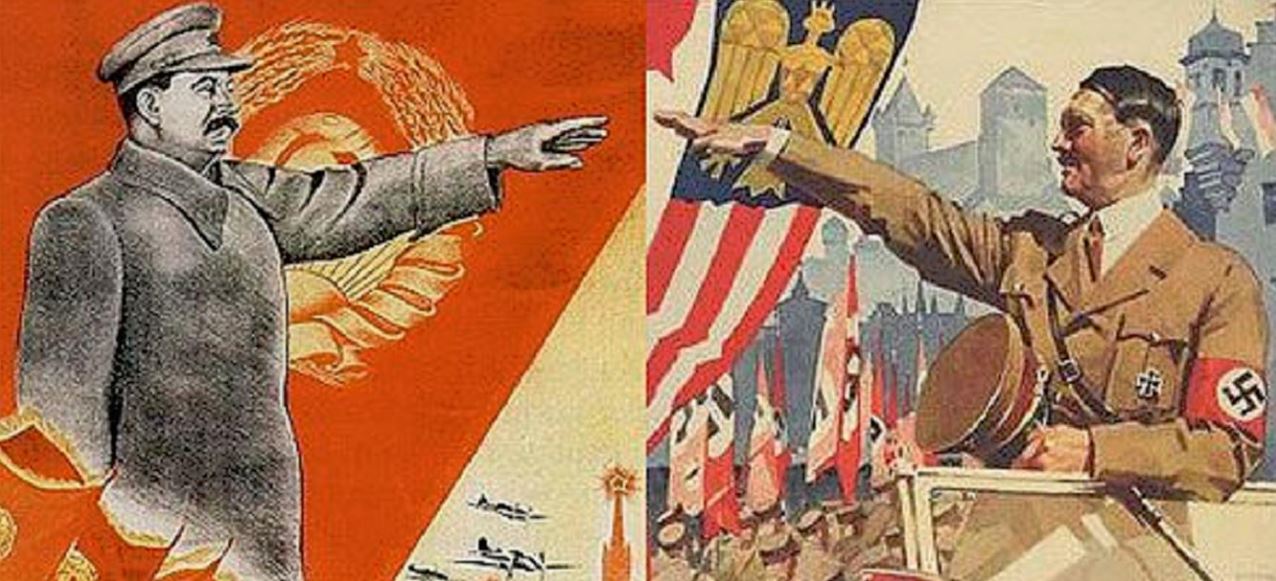
Stalin used propaganda to initiate a campaign that showed the public how close he was with its deceased leader Vladimir Lenin. In reality, Lenin did not like Stalin. In a testament written by Lenin in , he stated that he believed Leon Trotsky, the founder of the Red Army, would make a better leader. Stalin prevented the publication of the testament as another part of his Estimated Reading Time: 1 min STALIN PROPAGANDA AND REALITY: The reign of Josef Stalin was a time of terror, mass executions, brutal collectivization, and the most horrific “Stalin is a clerk”, Hitler said in , “and he has never stopped being a clerk”. As we have seen, Hitler loathed communism and those who preached and practised it. As early as , the Nazi leader predicted a “final battle between German race ideals and pan-Slav [Russian] mass ideals”.Estimated Reading Time: 8 mins

No comments:
Post a Comment